
Pressure: 01
International
2026
Sometimes the real discomfort isn’t in what happens, but in how quickly it is rewritten.
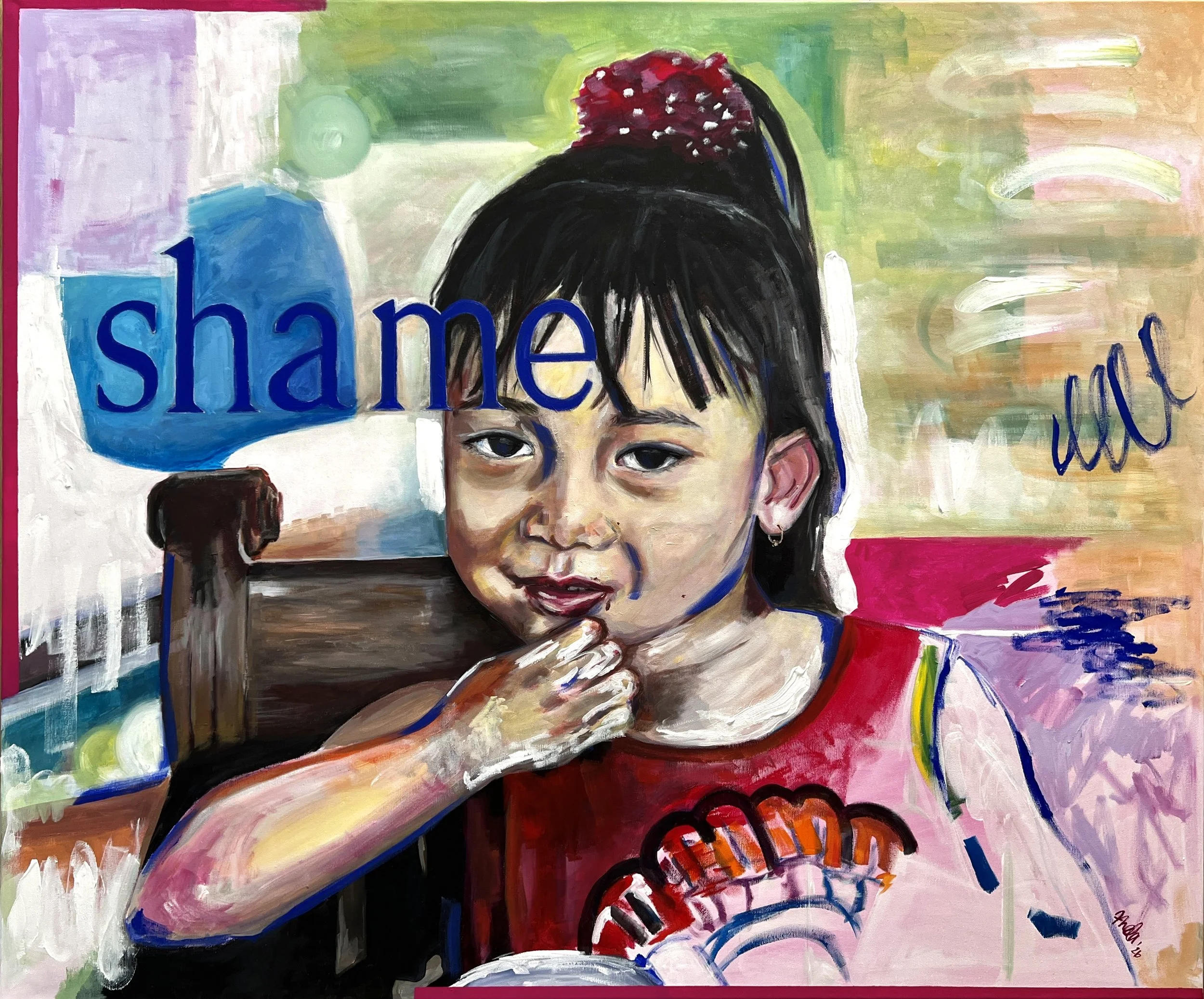
Shame
(Pressure series)
A moment that’s easy to overlook. The painting shows a toddler caught mid movement, with that upward drift of the eyes that happens before thought catches up. A hand lifts toward the mouth, small traces of food still visible. The expression reads as unbothered, not because it is intentional, but because nothing is being managed yet. It exists before judgment, before shame, before language. It is observation without commentary.
A toddler does not understand gesture in the way adults do. Meaning hasn’t been assigned yet. The body responds instinctively, before explanation. In the same way, people are often unaware of how their own preconceptions and lack of self integration shape the ways they cope, project, and construct meaning. What registers first is not control, but response.
Shame is often placed on another person in moments of uncertainty, when someone feels exposed or pressured. It is a word used to signal disappointment or fault, but it rarely lands where it belongs. Instead, it becomes a shortcut. A way to claim authority, preserve an internal image, or avoid staying present with what is actually unfolding. In crowning another with shame, the person often crowns themselves. What appears as judgment or moral clarity is more often an act of self-protection.
Pressure, then, tends to show itself indirectly. When someone cannot respond honestly or remain present, the exchange stalls. One person stays engaged, held together by a constructed exterior, while the other steps back. Meaning is left behind in that gap. The withdrawal mirrors the pressure itself. Once the space is exposed, nothing productive can come from reducing another person to a fixed narrative or imagined version. Shame becomes the residue of that avoidance, not the truth of the person it is placed on.
Some people are integrated enough to meet any outcome, favourable or not, with awareness. They participate fully, adjust when necessary, and accept responsibility for the directions they choose. Including the vulnerability that comes with remaining open rather than defended. When that awareness is absent, projection fills the space. Preconceived ideas replace observation. Moments are overwritten before they are understood.
The toddler in the painting points to what exists before all of this: presence, clarity, and unfiltered response. The contrast between that face and the act of crowning shame reveals how unnecessary, and almost absurd, it is to assign weight to another person’s moment without knowing it. When viewed from a distance, shame becomes strangely ironic. Often the real embarrassment lies not with the person being judged, but in the act of judgment itself.
This work observes how expectation meets limited awareness, how pressure exposes self-protection, and how shame is misapplied as meaning. It looks at what happens when moments are left unclaimed instead of met, when narratives are built and maintained from a distance rather than tested through participation. Because anyone can shape a story to confirm what they already believe. Or create an entirely new one, stitched together from contradiction and disguised as truth and authenticity.
So after all of that, what remains to be said?
What a shame.